RISK FACTOR
This project focused on designing an interactive map experience that could support nationwide property coverage while remaining fast, clear, and approachable for non-expert users. I led the UX and interaction design for core map workflows, address search, property selection, and risk visualization, ensuring the experience scaled across millions of parcels without sacrificing clarity or performance.
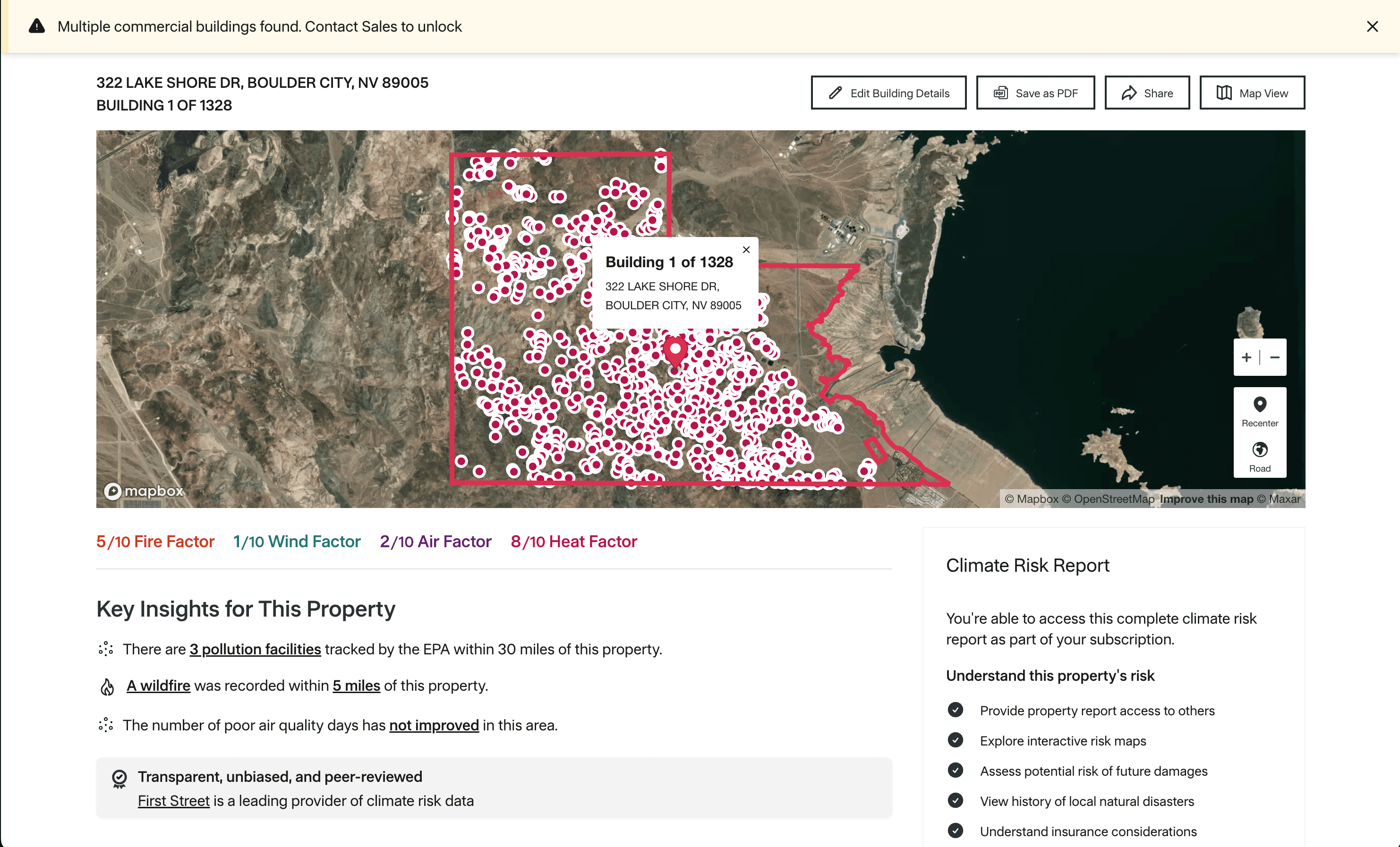
Executive Summary
The existing map experience made it difficult for users to confidently locate and understand property-level risk at scale. I led the redesign of map interactions, address search flows, and visual hierarchy to reduce ambiguity, improve usability, and support clearer decision-making across millions of properties.
25.5M
Properties supported nationwide
18%
Increase in successful property selection
Identifying Issues &
Designing Solutions
As coverage expanded nationwide, several usability challenges emerged around address accuracy, property selection, and map clarity. Users often encountered ambiguous search results, overlapping parcels, and dense map layers that made it difficult to identify the correct property and understand risk at a glance.
Problem
Address searches frequently returned multiple results, overlapping parcels, or imprecise locations. Without clear guidance, users struggled to confirm they were viewing the correct property, undermining trust in the data and slowing decision-making.
Design Approach
We focused on surfacing clarity early in the flow through explicit feedback, contextual prompts, and progressive disclosure. The goal was to help users resolve uncertainty quickly while preserving access to deeper, detailed map data when needed.
Fast-Track Design by Identifying and
Understanding Tool Gaps
To move quickly and reduce risk, we identified gaps in the existing map tooling and interaction patterns. Early exploration focused on validating how users searched for addresses, interpreted map feedback, and resolved uncertainty before committing to a property view.
Address Search & Property Disambiguation
Notifications
Popups
Banners
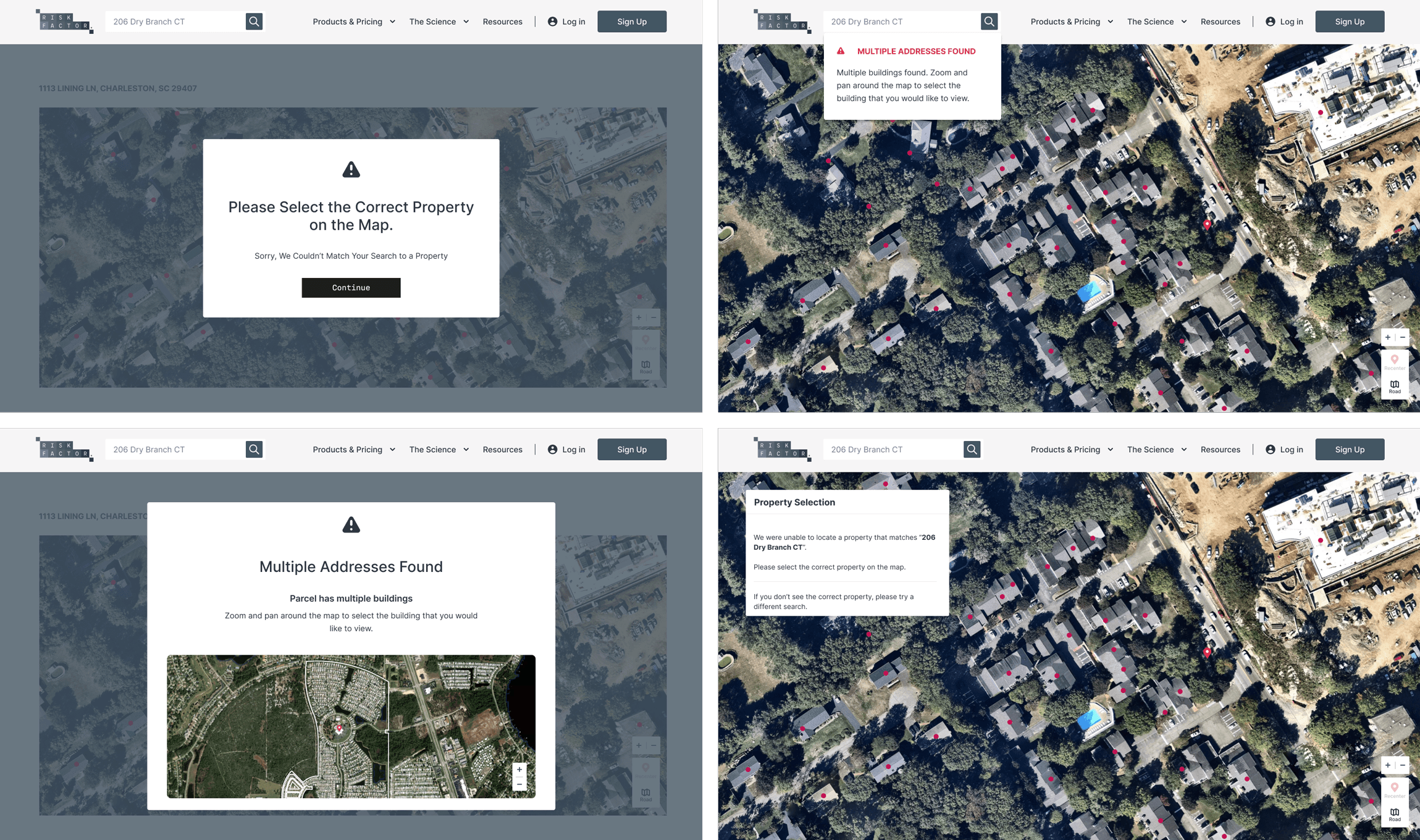
We Explored How to Notify Users of Address Search Issues
Early testing revealed that address searches often returned incomplete, ambiguous, or imprecise results, especially in rural or densely parcelled areas. We explored ways to proactively notify users when a search result required clarification, using clear messaging and visual cues to set expectations before users interacted with the map.
Representative explorations showing how the system surfaces search ambiguity and guides users toward confirmation.
Property Selection & Disambiguation
Selection States
Boundary Comparison
Error Prevention
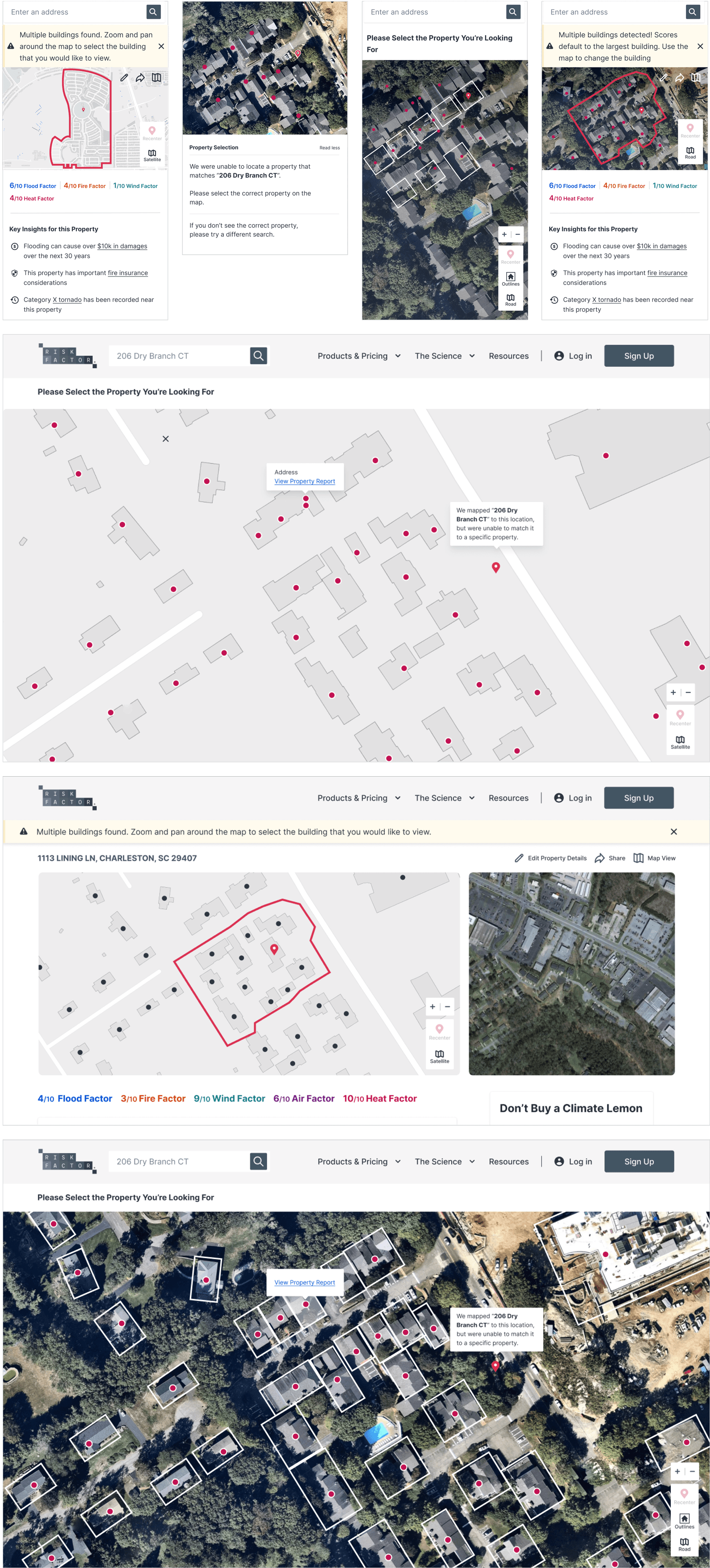
Helping Users Select the Correct Property
Once an address was located, users still needed to confidently identify the correct parcel among nearby properties. We designed interaction patterns that allowed users to compare boundaries, highlight selections, and confirm their choice directly on the map, reducing errors and increasing confidence before moving deeper into risk data.
Scaling Map Interactions Nationwide
Zoom-Level Logic
State Consistency
Performance Optimization
Standardizing Map Interactions for Scale
As coverage expanded to millions of properties, consistency became critical. We standardized map interactions, selection states, and visual feedback to ensure the experience behaved predictably across regions, parcel densities, and zoom levels—while maintaining performance and clarity.
Results & Impact
Clear Hierarchy
Consistent Patterns
Progressive Disclosure
Measurable Impact on
Engagement & Conversion
The redesigned map experience made it easier for users to find the right property and understand its risk at a glance. Clear search feedback, confident parcel selection, and consistent interactions at every zoom level reduced friction and kept users moving into deeper risk data.
25.5M
Properties supported nationwide
18%
Increase in successful property selection flows
22%
Reduction in re-searches
36%
Increase in completed property views
These changes established a scalable interaction model that continues to support new regions, data layers, and use cases.